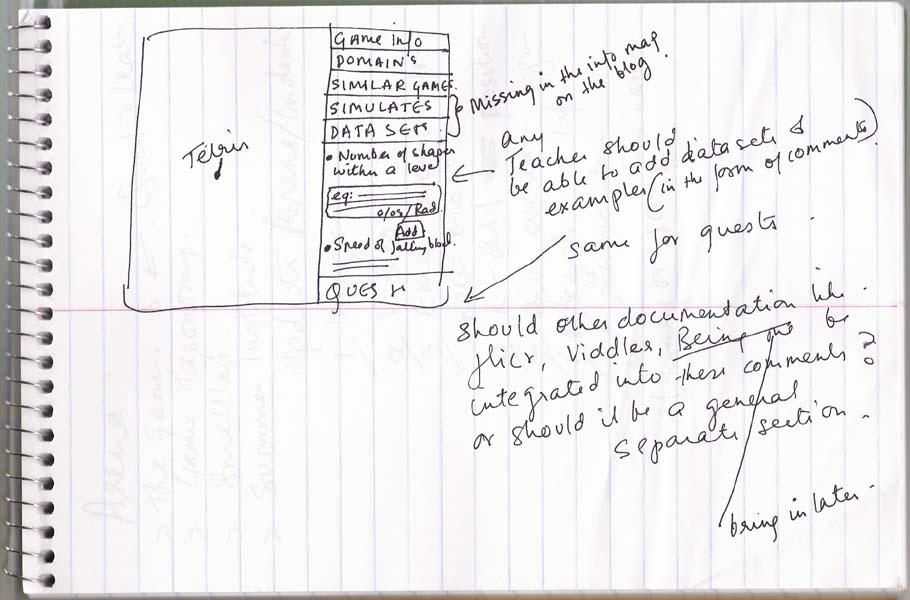
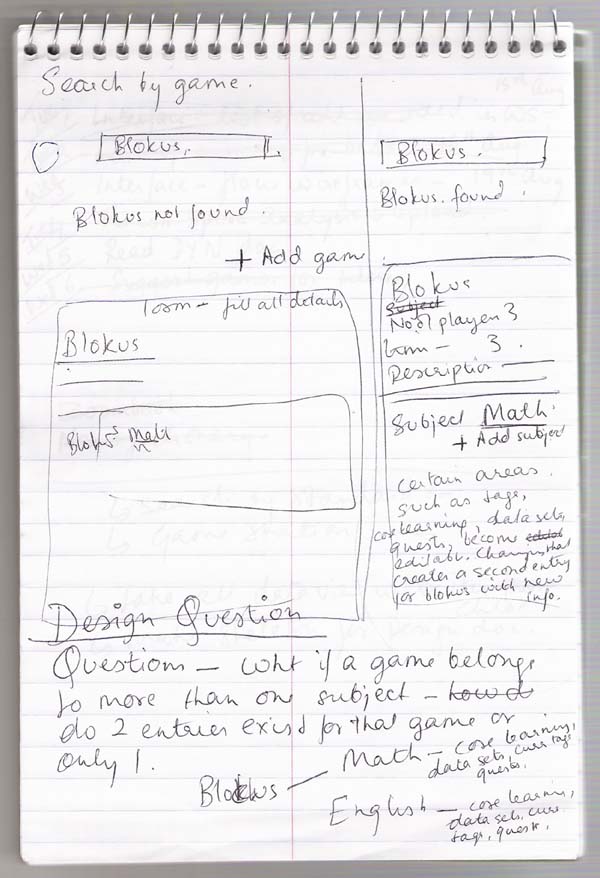
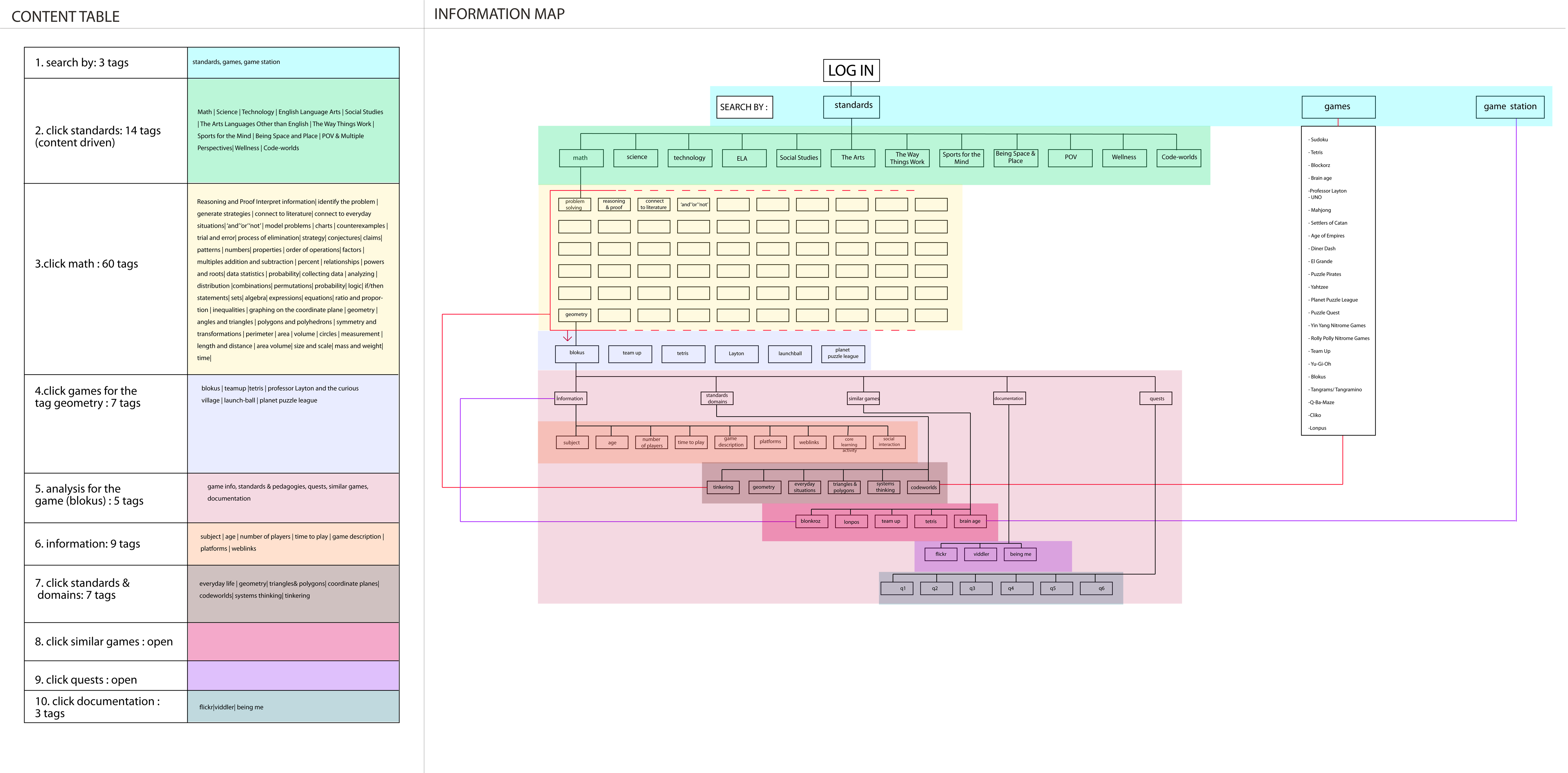
game taxonomy_information map

No comment »

data projects

http://www.smashingmagazine.com/2007/08/02/data-visualization-modern-approaches/

No comment »

rubric time

After looking into how the Music genome and Musicovery projects were build, i think it is a good idea to start a ranking throughout the standards. A first approach is to build a rubric map for playtesters to evaluate not only  in under what standard tag does a game they are playing fall into but also how much is it connected to that standard (through ranking). A good resource for rubrics  can be found here: http://www.exemplars.com/resources/rubrics/prim_science_rubric.html

No comment »

online taxonomy projects

I did some research around taxonomy projects today and here are my notes :

1) Music Genome project: A given song is represented by a vector containing approximately 150 genes. Each gene corresponds to a characteristic of the music, for example, gender of lead vocalist, level of distortion on the electric guitar, type of background vocals, etc. The system depends on a sufficient number of genes to render useful results. Each gene is assigned a number between 1 and 5, and fractional values are allowed but are limited to half integers. Given the vector of one or more songs, a list of other similar songs is constructed using a distance function. To create a song’s genome, it is analyzed by a musician in a process that takes 20 to 30 minutes per song. Ten percent of songs are analyzed by more than one technician to ensure conformity with the standards, i.e., reliability.

In addition to the above, Pandora features some cool user interface tools

If you scroll over the song that is playing you can contribute to the rating by choosing if you like the song or if you don’t like it so it doesn’t play again. Under the “Guide Us” option you’ll get these directions:
o Why is this song playing?
o I really like this song-play more like it
o I don’t like this song, it’s not what this section should play.
o I want to add more kinds of music to this station
o I’m tired of this station; let’s create a new one.

2) Musicovery
http://www.musicovery.com/

For each music track stored inside the Musicovery music library there are 30 descriptors with around 10 values each; values are ordered and then projected for each track on a 2D matrix, using the appropriate descriptors and a complete hierarchy for them. This generates a map of dynamic graphics that represents objects related by similarity or proximity attributes. This in turn enables navigation by proximity in a multi-dimension space (not pseudo 3D) and it does not require to externalize or verbalize the attributes on which each object is referenced.

Additionally, despite the crowded color scheme, Musicovery has a nice interface, much alike the taxonomy interface that we are trying to create. Here is a much explanatory post that takes a user through the interface: http://www.masternewmedia.org/news/2006/11/21/custom_streaming_web_radio_plays.html

No comment »

Curriculum Standards Tags

Math
Interpret information| identify the problem | generate strategies | connect to literature| connect to everyday situations| ‘and’ ‘or’ ‘not’ | model problems | charts | counterexamples | trial and error| process of elimination| strategy| conjectures| claims| patterns | numbers| properties | order of operations| factors | multiples addition and subtraction | percent | relationships | powers and roots| data statistics | probability| collecting data | analyzing | distribution |combinations| permutations| probability| logic| if/then statements| sets| algebra| expressions| equations| ratio and proportion | inequalities | graphing on the coordinate plane | geometry | angles and triangles | polygons and polyhedrons | symmetry and transformations | perimeter | area | volume | circles | measurement | length and distance | area volume| size and scale| mass and weight| time|

Science
Patterns | trends |sequence of events | cause and effect | classify objects | manipulate | structure and function | student generated taxonomy | position on a map | latitude, longitude | predict | generate| interpret| recognize| analyze| density | liquids | regular shaped solids | irregular shaped solids| simple and complex machines | energy | mechanical | kinetic | potential| transformation| conservation | force| simple and complex machines | friction | matter and energy | weather patterns| particle motion | phase changes | diversity | chains| unicellular and multi-cellular| flow | role | recycling | ecosystems vs interdependence | natural cycles | human impact| adaptation | growth | variation | elevation

Technology
Engineering design| technical solutions| general or social interest | research| collaboration| develop| plan| construct models| solution| test| design specifications| evaluate results| defections | machines | improve performance | manipulate components | growing systems | tools | material | resources | properties, costs, availability, and environmental impact | hand tools | adaptive| design criteria| choice| assemble | computer system | Internet | monitor | control | external events and/or systems| dimensions| prototype| open- and closed-loop | electrical, electronic, mechanical, and pneumatic systems | subsystems| system elements| inputs, processes, outputs| sensing information | processing | electronic kit | open loop systems| sensors | controllers| history and evolution of technology| shift in society| Information technology| retrieve| communicate information| text, pictures, and sound| Impacts of Technology| desired, undesired, expected, or unexpected outputs of a technological system| disposal | safety issues| Project management| profit| high quality| leadership| group activity| structure| work plan| time schedule| budget

EnglishLanguageArts
Research| locate information| understanding| collect and interpret data| use multiple sources| steps| overview| content| text features| organizational formats| identify missing. Unclear. Irrelevant information| fact and opinion| compare and contrast| prior knowledge or experience| critical analysis| evaluation |main idea| supporting details| distinguish| define| classify| interpret| facts| ideas| structure| content| vocabulary| condense| combine |categorize| confirm| predict| revise| draw conclusions| of explicit and implied information| genres| read| simile, metaphor, and personification| create meaning| reading| author| meaning| narrator| characters, plot, setting, and theme| point of view| symbolism, metaphor and simile, alliteration, personification, flashback, and foreshadowing| feelings,| repetition, rhythm, and rhyming patterns| poetry| cultural traditions| types of language| established and personal criteria| analyze| evaluate| conflicting information| support ideas| cultural and ethnic values| decoding strategies| syllable patterns| decoding by analogy| word structure| semantic cues| accuracy| recognition| high-frequency| content vocabulary| word meaning| prefixes| synonyms, antonyms| audience| edit| listening| speaking| feedback | writing| spelling| handwriting| composition|

SocialStudies
Eastern Hemisphere| history| time| turning point| event| periods| countries| continents| different cultures| POV| Neolithic revolution river civilizations| Mesopotamia| Egypt| China |Indus Valley| agriculture| world populations| technological innovations and effects on people, places | China, India, Greece, and Rome| Religions and other belief systems| Confucianism, Hinduism, Buddhism, Judaism, Christianity, Islam| networks of trade| Slavery| Middle Ages and Renaissance| long distance trade routes | linking| Africa, Asia, and Europe| literature| music| painting| sculpture| architecture| genocide Nazi| geography| grids| symbols |notations| maps| surface| globes| aerial | photographs| satellite-produced images| models| spatial organization| places| regions| physical settings| human systems| environment and society.| region| climatic conditions| land use| physical| political, economic, or cultural features| diversity| migration| overpopulation| widespread poverty| urbanization| effect| economy| goods and services shall| what, how and for whom| the economic, political, historic, global impacts of resource usage| health| population growth| diversity in living standards| scarcity| supply and demand| markets| opportunity costs| resources| productivity| economic growth| systems| interdependent network | patterns of consumer purchases| production and distribution| “mixed” economies| development| growth| free trade| common economic policy| interdependent| leadership| global economy| market economies| governments | settlement patterns| power| authority| governance| law| human rights| human needs| constitutions| political boundaries| totalitarian societies| United Nations| rights and responsibilities

No comment »

NYC curriculum standards pdfs’

below are all the 6th grade standards for Math, Science, Technology, ELA and Social Studies, in a pdf format, cleaned and unified as to style and numbering. This will be the basis for developing a Rubric next week that will be used in the game taxonomy analysis.

maths-standards-for-sixth-grade

science-standards-for-sixth-grade

technology-standards-for-sixth-grade

ela-standards_writing_-for-sixth-grade

ss-standards-for-sixth-grade

No comment »

Taxonomy Excel Model

here is the excel document that contains a model taxonomy for ten games related to math

No comment »

search by game

Below are wireframes of the game taxonomy website depicting a step by step search pursued by a student. Firstly student Rowdy logs in his account. He has been assigned by his teacher to play ‘blokus’. thus he selects ‘blokus’ from the search by game bar. In the ‘blokus’ nest he can learn more about the game play under the information option. Then he can see documentation posted by students and teachers in flickr and vlogger as well being me and finally he can check the option similar games, in case he want to play more games that are like ‘blokus’..

No comment »

search by subject

Below are wireframes of the game taxonomy website depicting a step by step search pursued by a teacher. Firstly teacher miss Sunshine logs in her account. From the options that appear in the first screen she selects search by subject. She selects maths and then from the nest of options that appear, she selects geometry. From there, she scrolls through the suggested games and selects the game ‘blokus’. In the ‘blokus’ nest she can learn more about the game, and find guidelines as to how this game can be used within the context of the gameschool, under the information option. Then she see documentation posted by students and teachers and finally she can check the option similar games.

No comment »

information architecture concept diagrams for the taxonomy site

The following concept maps depict the last two iterations for the architecture of the taxonomy site.

We are moving forward with the first iteration as depicted below. Elements of the second iteration will be integrated in the being me engine.

pink: search by taxonomy standard | yellow: search by game

pink : teacher | yellow : student | blue : parent

No comment »